Lecithin Plant Manufacturers

Global Lecithin Plant Manufacturers – Turnkey Solutions, Engineered in India.

What is Lecithin?

Lecithin is a complex mixture of phospholipids, primarily derived from plant sources like soybeans, sunflower seeds, and rapeseed. It is widely used as an emulsifier, stabilizer, and preservative in various industries, including food, cosmetics, and pharmaceuticals.


Lecithin’s composition includes key phospholipids such as Phosphatidyl Choline (PC) and Phosphatidyl Ethanolamine (PE), which contribute to its functional properties in formulations. 

Technology

The production of lecithin involves several advanced technologies designed to extract, refine, and modify lecithin to meet specific industry requirements.

The primary technologies used in lecithin production include:

Traditional Extraction

This process involves the extraction of lecithin from crude vegetable oil through a water degumming process. The gummed oil is treated with water, followed by centrifugation to separate the lecithin-rich phase.

Hydrolyzed Lecithin Production

Hydrolysis is employed to modify the phospholipid structure, enhancing lecithin's solubility and functionality in various applications. This process is particularly useful in producing lecithin for food and cosmetic industries.

Powder Lecithin Production

This involves the drying of liquid lecithin to obtain a powdered form. Technologies such as spray drying, or vacuum drying are utilized to produce lecithin powder with desired characteristics.

Agitated Thin Film Evaporation (ATFE)

A specialized technique used in lecithin processing to achieve a highly concentrated and purified product by efficiently removing solvents and volatile components.

process

Process

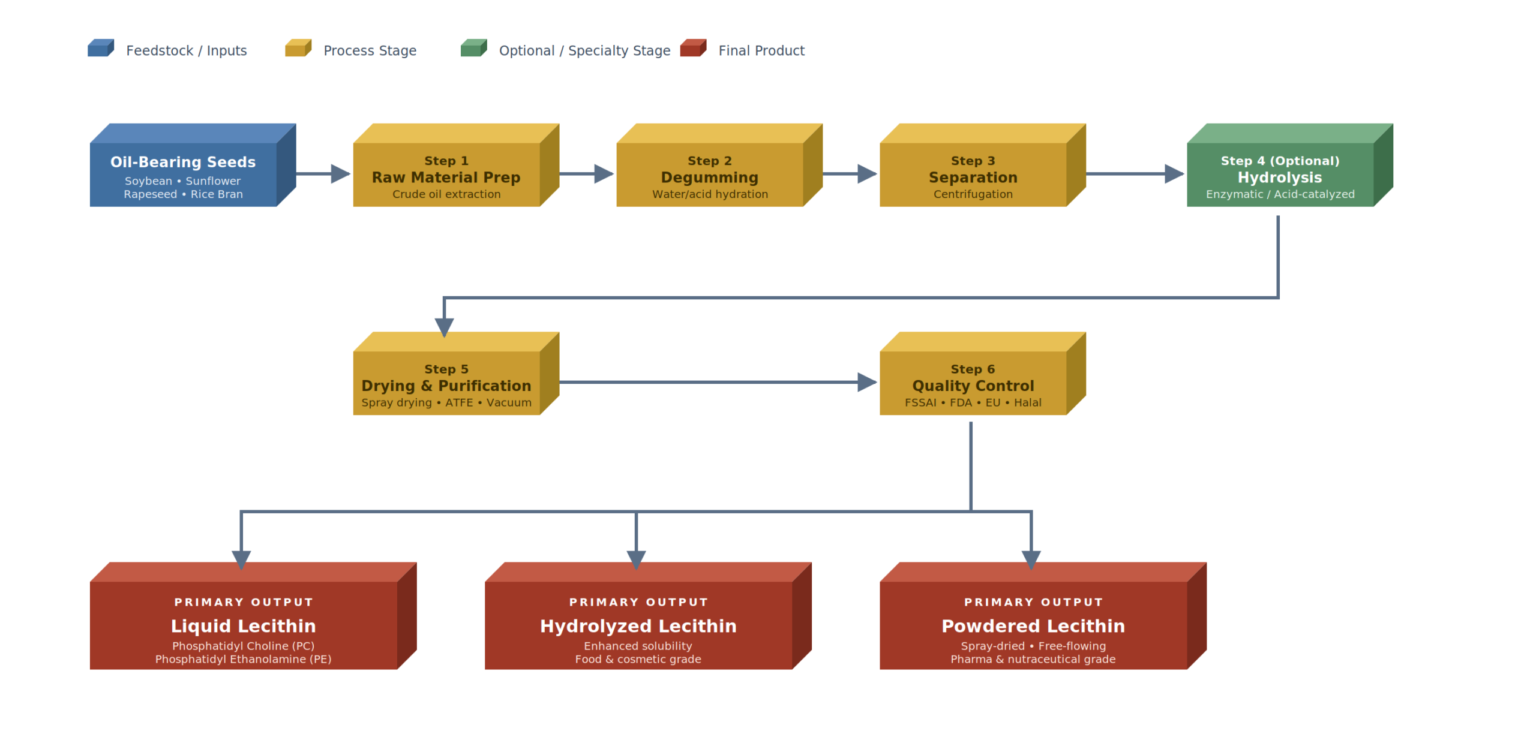
  • Step 1

    Raw Material Preparation

    Lecithin production begins with the selection and preparation of oil-bearing materials such as soybeans or sunflower seeds. The crude oil is extracted using mechanical or solvent extraction methods.

  • Step 2

    Degumming

    The crude oil undergoes degumming, where water or acid is added to hydrate phospholipids, facilitating their separation from the oil. The hydrated phospholipids form a gum phase, which is rich in lecithin.

  • Step 3

    Separation

    The gum phase is separated from the oil through centrifugation. The resulting crude lecithin is further processed to remove impurities and achieve the desired concentration and composition.

  • Step 4

    Hydrolysis (if required):

    For hydrolyzed lecithin, the crude lecithin undergoes enzymatic degumming or acid-catalyzed hydrolysis, altering the phospholipid structure to enhance its solubility and emulsifying properties.

  • Step 5

    Drying and Purification

    The lecithin is then dried using technologies such as spray drying to produce powdered lecithin. Additional purification steps may be employed to achieve specific grades of lecithin, such as single or double-bleached lecithin.

  • Step 6

    Quality Control

    The final lecithin product is subjected to rigorous quality control tests to ensure compliance with industry standards and customer specifications.

Advantages of Lecithin Plant provided by Muez Hest

Get A Quote to discuss
your manufacturing requirements

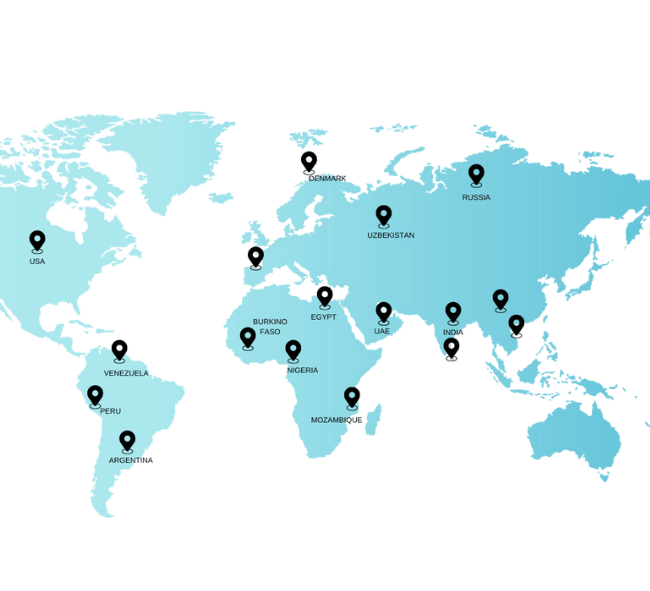
Muez Hest Global client reach map

Global Installation

Global Installation

Strategies to ensure proactive domination. At the end of the day,User generated content in real-time will have multiple touchpoints for offshoring.

  • 0
    Project completed
  • 0
    Satisfied client
  • 0
    Year of experience
  • 0
    Qualified specialist

Our Clients

We worked with royal clients

Read More

Trusted Global Lecithin Plant Manufacturers - Engineered in India


As one of the most trusted lecithin plant manufacturers with global reach and three decades of engineering excellence headquartered in India, Muez Hest designs, manufactures and commissions advanced lecithin plant setup systems for clients across India, Southeast Asia, Africa, Latin America and the Middle East. Our turnkey lecithin plants extract, refine and modify lecithin from soybean, sunflower, rapeseed and rice bran feedstocks to meet international food-grade, pharma-grade and cosmetic-grade specifications.


End-to-End Turnkey Lecithin Plant Solutions


Setting up a profitable lecithin manufacturing plant requires far more than equipment - it demands integrated process design, validated technology and reliable post-commissioning support. Muez Hest delivers all of it under a single turnkey contract: from feasibility studies and process simulation to detailed engineering, equipment fabrication, installation, commissioning and operator training. Whether your facility focuses on liquid lecithin, hydrolyzed lecithin or powdered lecithin, our modular plant designs scale from pilot capacities to full industrial throughput.


Why Global Brands Choose Muez Hest as Their Lecithin Plant Manufacturer


Advanced Technology Stack — Our lecithin plant setup incorporates Agitated Thin Film Evaporation (ATFE), enzymatic hydrolysis, spray drying and vacuum drying — all engineered for high yield, low solvent residue and consistent phospholipid composition (Phosphatidyl Choline, Phosphatidyl Ethanolamine).


Multi-Feedstock Flexibility — A single Muez Hest lecithin plant can be engineered to handle soybean, sunflower, rapeseed or rice bran feedstock with minimal reconfiguration - protecting your investment as global feedstock economics shift.

International Compliance — Plants are built to FSSAI, FDA, EU and Kosher/Halal certification pathways, making your output export-ready from day one.


30+ Years of Manufacturing Heritage — Headquartered in Mumbai, India, with installations across multiple continents, Muez Hest brings deep oleochemical and edible oil engineering DNA to every lecithin plant project.


Sustainable Engineering — Energy-efficient evaporation, closed-loop solvent recovery and minimal-effluent designs aligned with global ESG benchmarks.


Industries We Serve Globally


Muez Hest lecithin plant manufacturing services power production lines for food and beverage emulsifier suppliers, infant nutrition and nutraceutical brands, bakery and confectionery ingredient houses, cosmetic and personal-care formulators, and pharmaceutical excipient manufacturers - across India and 30+ countries worldwide.


Plant Setup, Backed by Global Engineering Expertise


When you partner with Muez Hest as your lecithin plant manufacturer, you gain a single accountable engineering partner - not a vendor relationship. From process licensing and basic engineering packages to mechanical fabrication, piping, instrumentation and DCS automation, every element of your lecithin manufacturing plant is delivered under one roof. Contact our engineering team to discuss capacity, feedstock and end-product specifications for your next lecithin plant project.


Contact us on +91 2240050543 or Get a quote today to explore how we can support your next lecithin manufacturing plant setup.


faq

Frequently Asked Questions

Discover some of the most asked questions regarding Lecithin Plant.

Lecithin is primarily derived from oil-bearing seeds such as soybeans, sunflower seeds, rapeseed, and rice bran.

Lecithin functions as an emulsifier, stabilizer, moisturizer, and preservative, making it an essential ingredient in various formulations.

Hydrolyzed lecithin undergoes a process that alters its phospholipid structure, enhancing its solubility and functional properties in food and cosmetic applications.

Powdered lecithin is commonly used in the cosmetic industry as a thickening agent, in food products for texture enhancement, and in pharmaceuticals for stabilization.

Muez-Hest offers advanced technology, custom solutions, and high-quality lecithin products that comply with industry standards, making them a reliable choice for lecithin production.

Go To Top